Celilo Falls
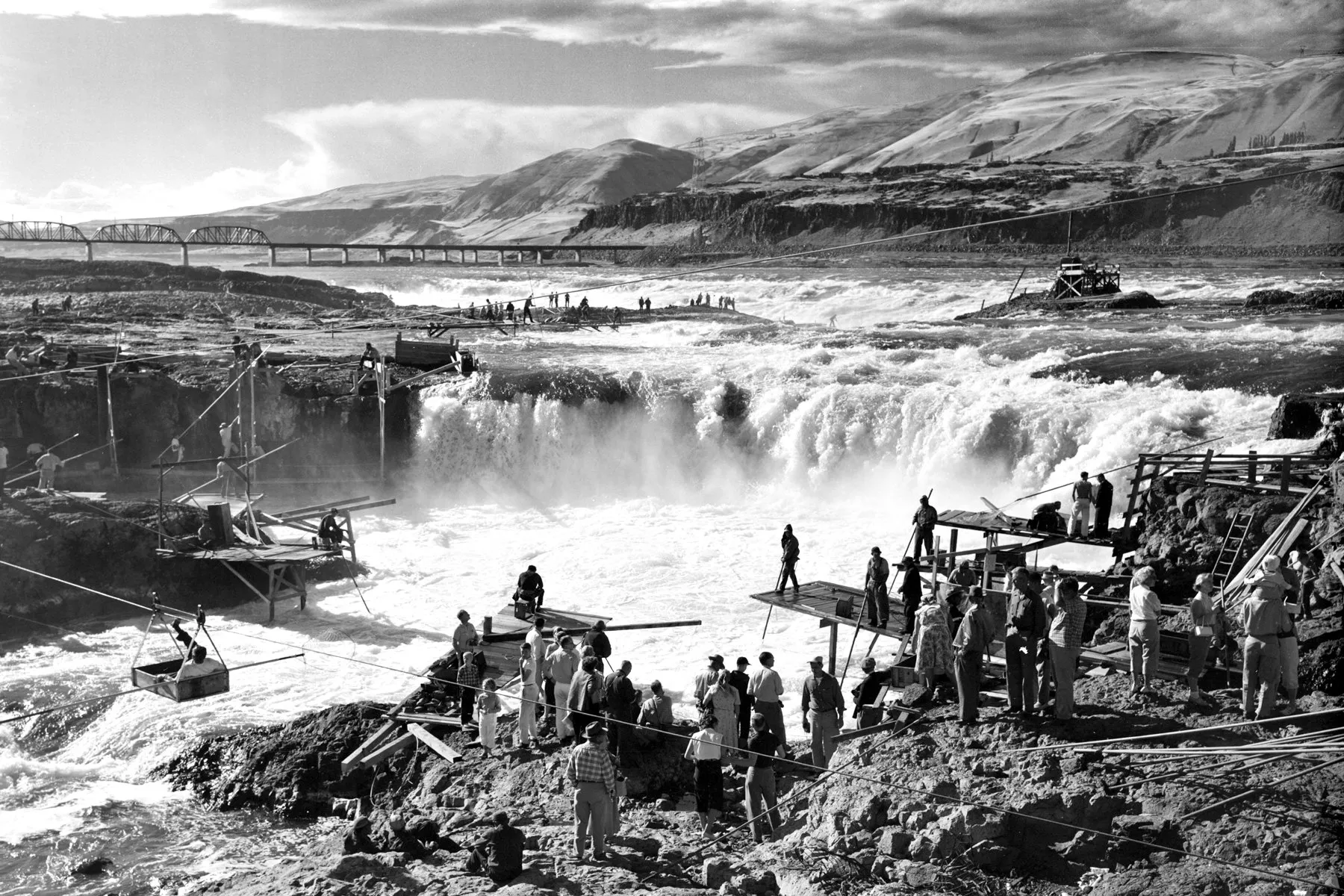
Fishing platforms and onlookers at Celilo Falls on the Columbia River, the great tribal fishery drowned by The Dalles Dam in 1957. The exact date of this frame is not recorded; the Oregon Trunk railroad bridge, opened in January 1912, stands on the horizon, so it was made between 1912 and 1957.
Photo-Art Studio commercial archive (Portland, Oregon); acquired by Stephen Ingham 2001. Donated to the Oregon Historical Society in two parts — the bulk in 2002–2003 and the remainder in 2007 (Org. Lot 791); editorial rights retained.
The story
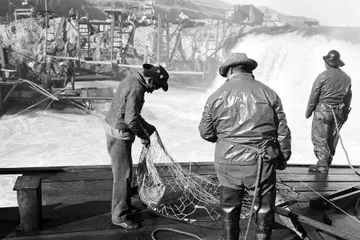
Tribes fished at this narrows of the Columbia for thousands of years. They called the falls Wy-am. Men fished from wooden platforms built out over the water, with long-handled dip nets, and the fishing sites passed down through families. Cable cars carried fishermen out to the islands. Seufert Brothers, the cannery at The Dalles, supplied scrap lumber for the platforms and from 1930 built aerial cableways to the islands; fishermen who rode them sold their catch to the company.
On the morning of March 10, 1957, the gates of The Dalles Dam closed. About four and a half hours later the falls were under water.
The date of this frame is not recorded, but the picture sets a limit of its own. The railroad bridge on the horizon at left is the Oregon Trunk bridge, which opened in January 1912, so the frame was made between 1912 and the closing of the dam in 1957. A man whose parents ran the Celilo Falls Cafe, above the falls, wrote that this picture hung in the cafe, and remembered it as Chief Tommy Thompson of the Wy-am people on his island during a flood in 1909; the bridge means that memory belongs to a different picture or a later year. Another reader owns a copy with a note dating it to 1948. People who watched the fishing in the late 1940s say the platforms looked like this, and several think the clothing belongs to the 1940s or early 1950s. Some also ask whether the print is reversed left to right. The exact year, and the orientation, remain open.
The picture was widely known. One reader remembers prints of this view given as gifts in the late 1950s; others grew up with it on the wall at home, and one says it hangs in many offices in The Dalles.
When it was shared in Oregon and Columbia Gorge history groups in 2026, many people who saw the falls wrote in. They remember Sunday drives and school trips to watch the fishing, the roar and the spray, the smell of salmon drying on racks, women cooking salmon on sticks over a fire, and buying fish straight from the tribal fishermen on the way home, a trade that carries on near The Dalles today. One reader saw salmon-smoking camps on the Washington shore in 1956. Another remembers that every man on the platforms had to tie a rope around his waist. Several families were there when the gates closed in 1957; one woman’s father, a welder on the dam, took her to watch.
Some knew the fishing from closer in. One woman rode a cable car out to the fishing in 1953 and spent the night with a Native family. A man’s grandfather, a shoe merchant in The Dalles, was allowed by tribal friends to fish with them. Another reader’s father fished off to one side, because the tribes had the first rights.
Know something about this photograph? Write to licensing@photoartstudioarchive.com.