Salmon Fisherman Rowing a Loaded Skiff, 1940s
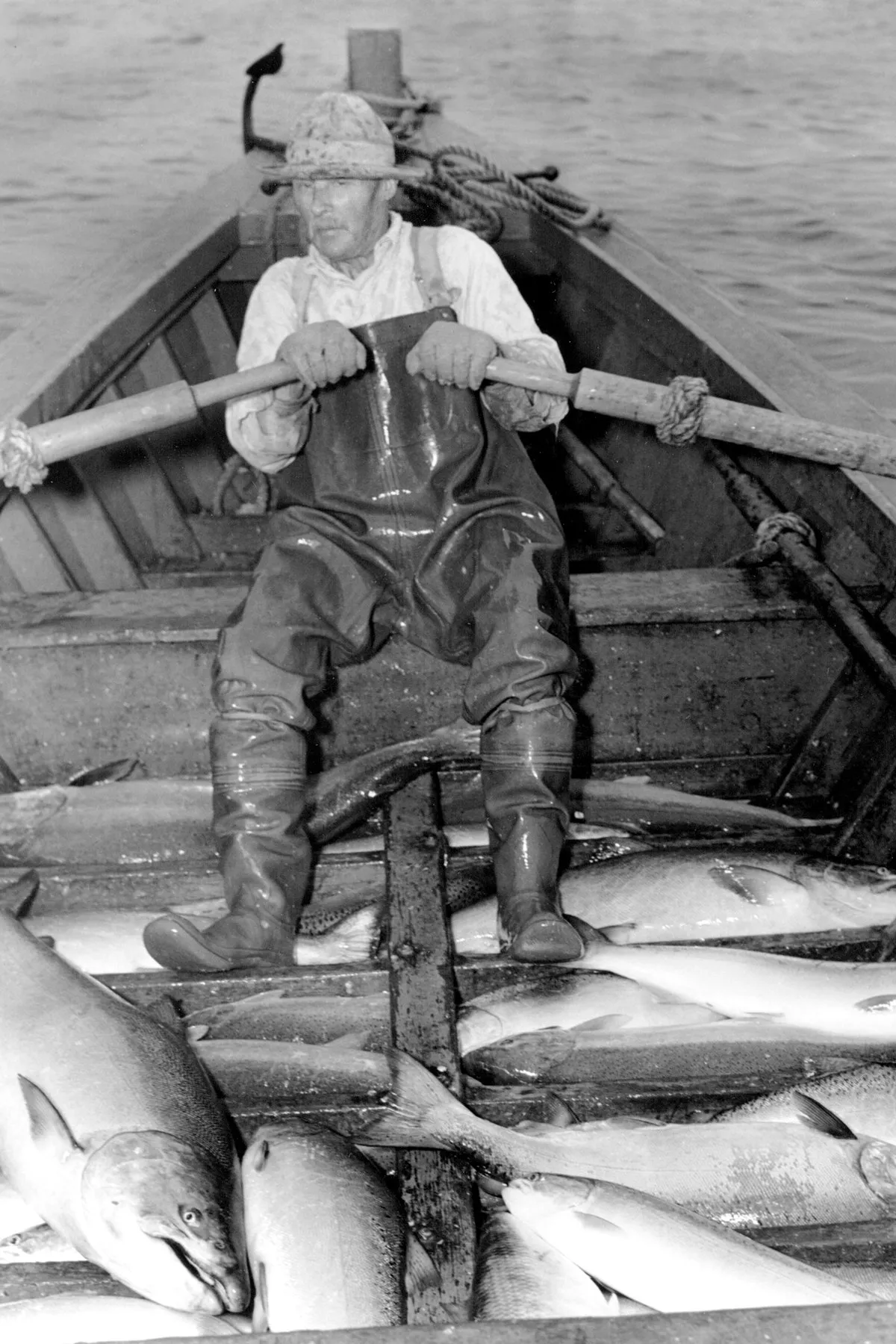
A fisherman rows a skiff loaded with salmon somewhere on the Pacific Northwest coast or the lower Columbia. Fishermen who saw the picture identify the boat as a trap skiff, used to haul fish from salmon traps. Date and place are not recorded.
Photo-Art Studio commercial archive (Portland, Oregon); acquired by Stephen Ingham 2001. Donated to the Oregon Historical Society in two parts — the bulk in 2002–2003 and the remainder in 2007 (Org. Lot 791); editorial rights retained.
The story
The boat is probably not a dory, but the fishermen who saw this picture in 2026 do not agree on what it is. Several identify it as a trap skiff, the kind used to haul salmon from the fish traps that stood in the lower Columbia until Washington banned them in 1934. A fisherman who knew the traps points to a kedge anchor in the bow and to fish with no net marks, which suggests a catch lifted from a trap rather than taken in a gillnet. Others see a horse-seining scow or a gillnet tender. The man rows with his oars held in rope oarlocks, and he wears chest waders, not hip boots.
His name is not known, and neither is the place, though most readers put him on the lower Columbia near Astoria. The photograph is credited to Claude Palmer of Photo-Art Studio. One reader sees a Navy vessel of the Second World War in the background, which would fit the archive’s 1940s date; that has not been checked against the negative.
The catch drew its own comments. One fisherman judged the largest fish at about 45 pounds, big but short of the giant “June hog” chinook that ran up the Columbia before Grand Coulee Dam closed off the upper river. Others pick out a steelhead among the salmon.
A boatbuilder who studied the picture in a wooden-boat group says that, whatever its type, the skiff was probably built the way Banks dories were: upside down over a frame, its planks bent on and fastened with galvanized boat nails, likely Douglas fir throughout, and never painted, since it was expected to last only a couple of seasons. The rope rings on the oars, he says, held them in place when the fisherman let go to work the net. Other readers agree it was a heavy boat to row, and one remembers working the oars for his grandfather while he hauled in the big fish.
Many of the salmon fishermen in Oregon and Washington came from Norway, Finland, Sweden and the rest of Scandinavia. When the picture was shared in Norwegian heritage and Astoria history groups, families wrote about fathers and grandfathers who fished out of Astoria, Ballard, Puget Island and Cathlamet: men who rowed out to the traps before dawn, worked seines with horses on the river sand bars, and rowed out at night to light the lanterns on the channel markers. One man remembered rowing boats like this one, in the years before motors were affordable.
Know something about this photograph? Write to licensing@photoartstudioarchive.com.