The General Bridge Wreck, Row River, Oregon, 1926
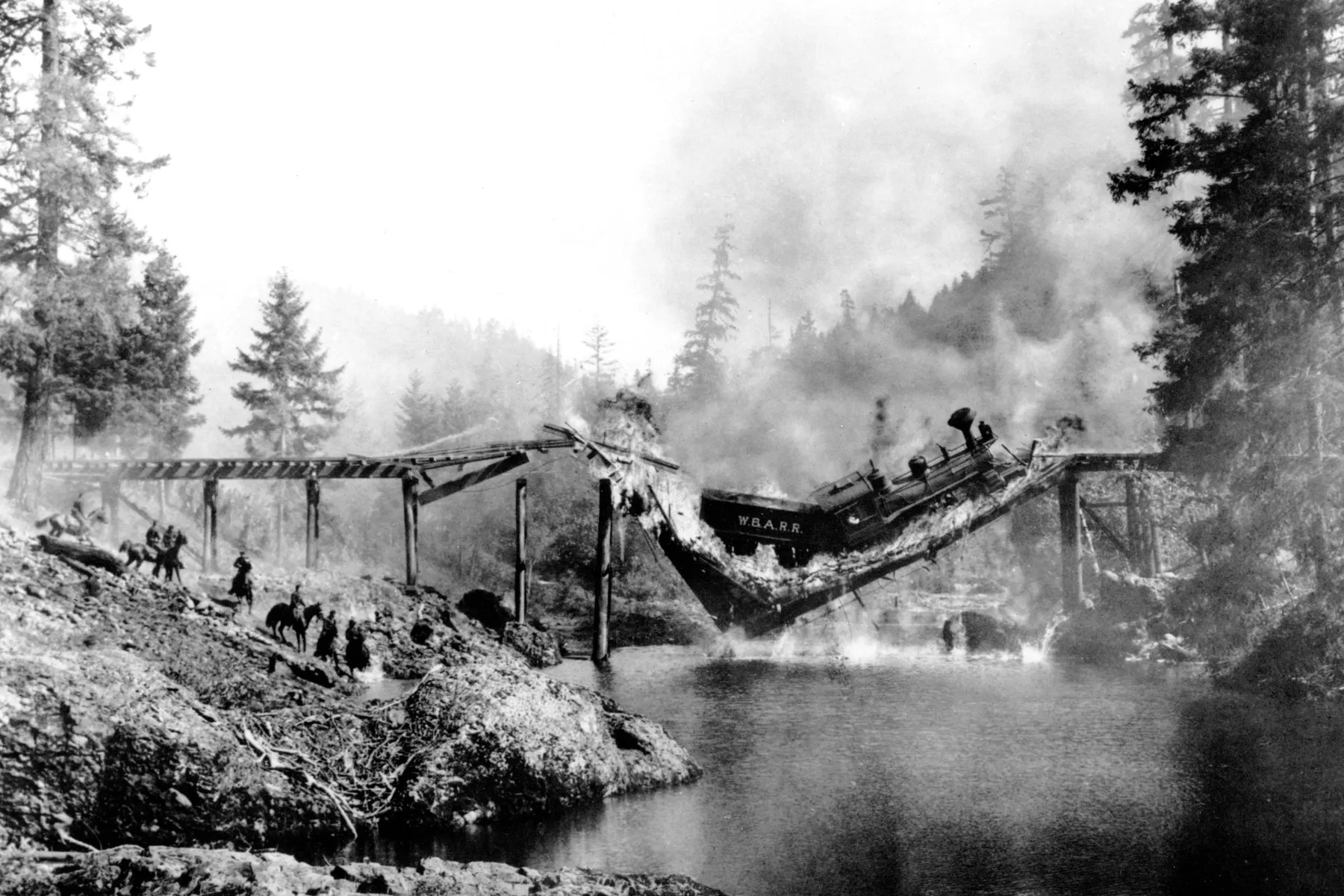
The bridge-wreck scene from Buster Keaton's The General, filmed on the Row River south of Cottage Grove, Oregon, on July 23, 1926. A locomotive runs onto a burning trestle built for the film and falls through it into the river; the tender is lettered W.&A.R.R., for the Western & Atlantic of the film's Civil War story. Horsemen watch from the bank.
Photo-Art Studio commercial archive (Portland, Oregon); acquired by Stephen Ingham 2001. Donated to the Oregon Historical Society in two parts — the bulk in 2002–2003 and the remainder in 2007 (Org. Lot 791); editorial rights retained.
The story
This is not a real railroad accident. On July 23, 1926, Buster Keaton’s company ran a locomotive onto a burning trestle over the Row River, south of Cottage Grove, Oregon, and let the bridge give way beneath it. The scene is the climax of The General, released the following year. The tender is lettered W.&A.R.R., for the Western & Atlantic, the Georgia railroad in the Civil War story the film tells.
Hundreds of people from the valley were hired as extras, and thousands more came out to watch. When the picture was shared in an Oregon history group in 2026, their families wrote in. One man says his grandfather was a teenage extra and that the whole town turned out for the wreck; he also heard that Keaton played baseball with the locals. Another family says their great-grandparents helped feed the film crew, and a third says a grandfather helped build the trestle. Another man says his grandfather was an extra who rode as cavalry for both armies, the blue and the grey, and that the family still has the swords he carried in the film.
When the picture ran again later that month, more families wrote in. One woman says the cavalry horses, riders and cannons came from the ROTC at Oregon Agricultural College, now Oregon State, and that her father rode as one of the soldiers. A man says his grandfather, an engineer on logging railroads, drove the locomotive during the filming; another says his grandfather and a great-uncle helped fire up the engine. A woman grew up in the house where soldiers march down South 16th Street at the end of the film, and one family still keeps a bell that a Cottage Grove boy took from one of the film’s engines as a souvenir.
Readers who grew up along the Row River place the camera near Culp Creek, looking into the river, close to where the Bohemia lumber mill later stood. One puts it just above the old Culp Creek grade school.
The wrecked engine was left where it fell. A woman born nearby in 1939 swam in the river beside it. People in the valley remember that it was cut up for scrap during or after the Second World War, and one man’s uncle kept pieces of it. A man who grew up at Culp Creek in the 1950s remembers parts of the engine and the bridge still lying on the river bottom then. Bits of track and steel still show in the river at low water.
The archive does not record who made this negative, or how it came to the studio.
Know something about this photograph? Write to licensing@photoartstudioarchive.com.